The heavy infantry melta gun is the most devastating weapon available to Terminators with the appropriate marksman specialization. It is employed to destroy large concentrations of heavily armored infantry, bunkers, and light to medium armored vehicles. It inflicts catastrophic morale damage on the enemy. There have been cases where the enemy surrendered solely on rumors that this weapon was being deployed against them.
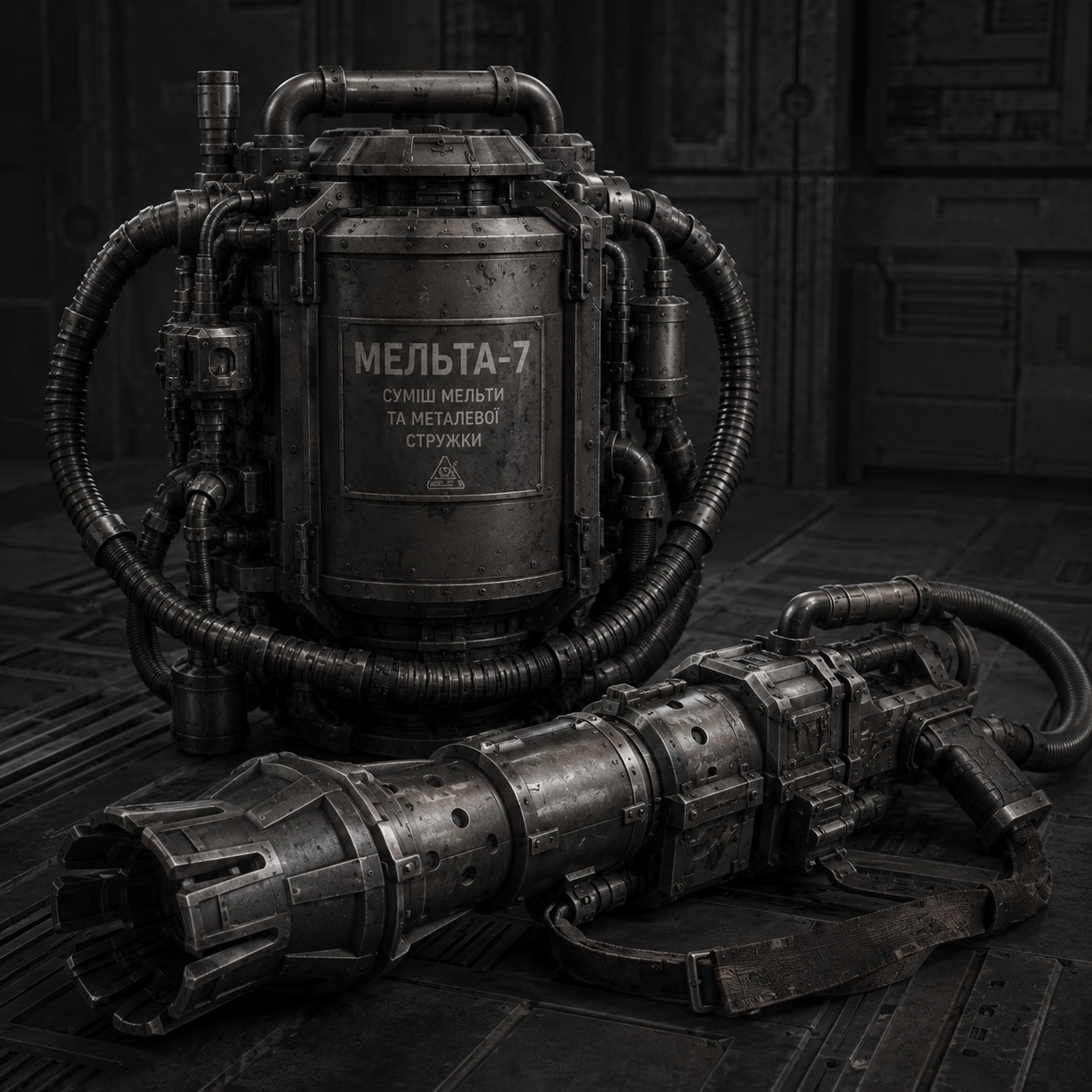
Unlike plasma weaponry, which strikes a target with a compact clot at range, melta works differently: it emits a narrow stream of superheated plasma bound with overheated metallic aerosols. This jet-like substance flies at bullet speed and burns through everything in its path. The closer to the target — the hotter the stream and the deeper the penetration. At close range, no armor can withstand it.
A shot from a melta gun is an event. First, you hear the low hum of the generator, then the air in front of the barrel begins to shimmer from the heat, and in a fraction of a second — an extremely loud blast. The heating of the atmosphere creates a shock wave that can, on its own, knock unprotected infantry near the shooter off their feet. At the point of impact, the metal glows white, armor melts and drips in incandescent droplets, leaving behind a neat burned-through hole or an entire breach. The crew of armored vehicles inside often dies before the melta fully passes through the armor — simply from thermal shock.
The main drawback is range. The melta stream quickly disperses in the atmosphere, so already at a hundred meters, penetration capability drops sharply. This is a close-quarters weapon, and the gunner always goes in the front ranks. In vacuum, the melta performs somewhat better — there is no atmosphere to disperse the stream — but it is still not a long-range weapon.
Energy consumption is enormous. Most models are powered by swappable ultra-high-density energy cells or are connected directly to a backpack reactor. After three to four shots, the automation blocks the trigger — the emitter chamber glows to critical temperatures, and if you don’t let it cool down, the weapon will simply melt in your hands. Veteran gunners know: melta does not forgive haste.
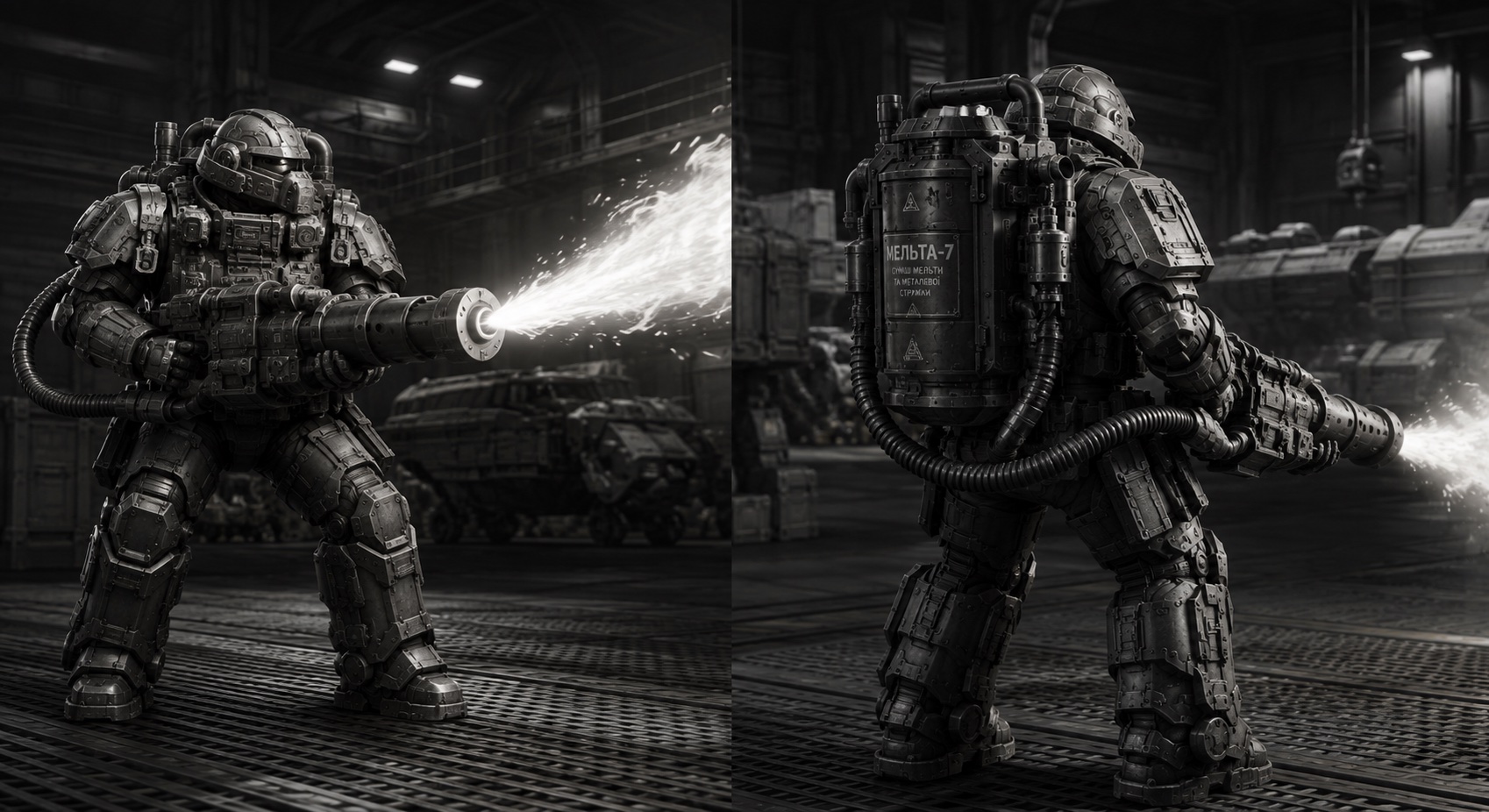
Modifications
Melta Gun-7 “Peklo” (Hell)
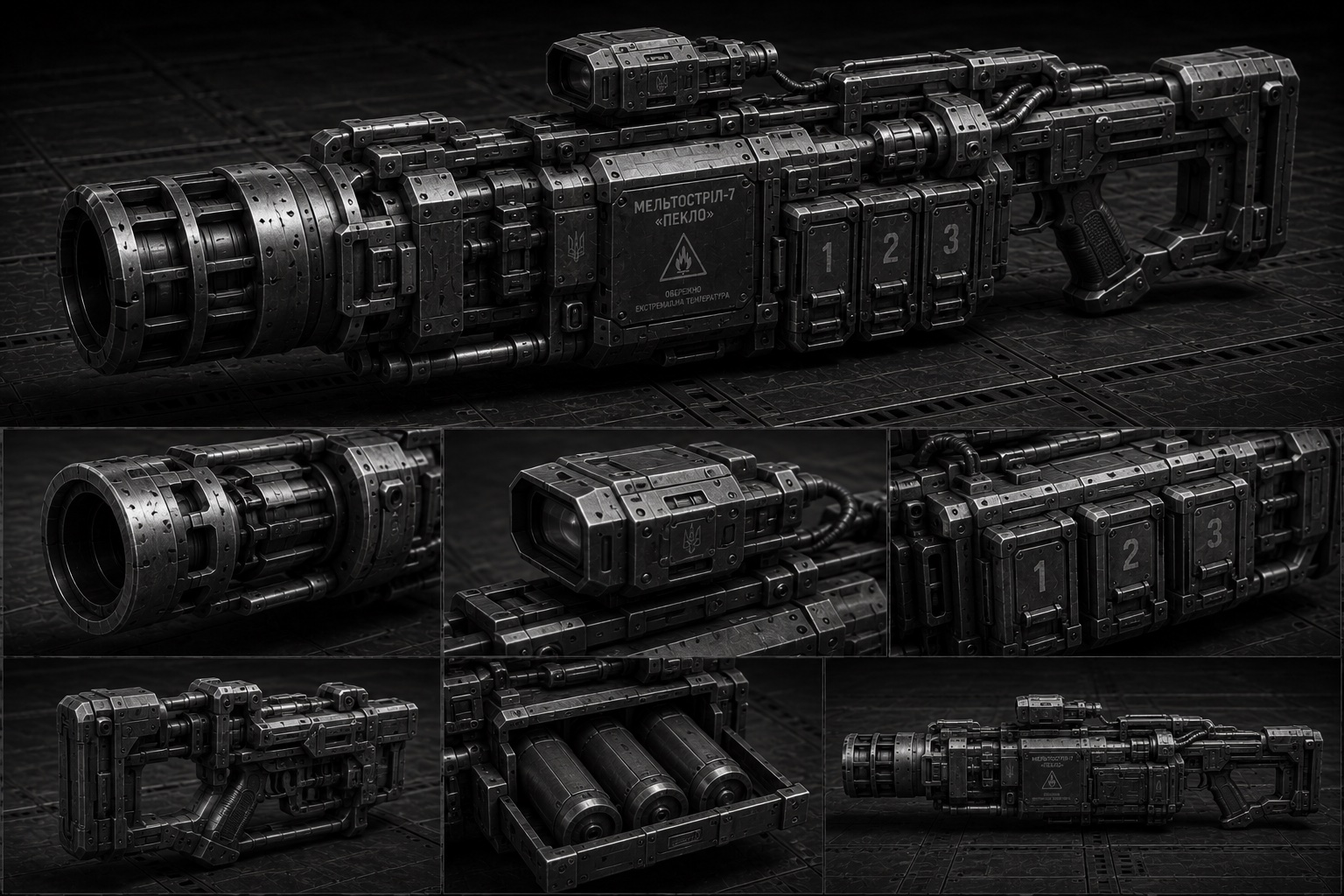 The base model from which all others descended. Weight in combat configuration is ninety-two kilograms, and that’s not just a number: “Peklo” is the heaviest, most powerful, and least compromising melta gun in the Hetmanate’s arsenal. It carries three swappable energy cells in the magazine, one per shot. The sight is a collimator with a thermal sensor, because through air shimmering with heat, conventional optics are nearly useless. The stock is fixed, designed for an operator in powered exoskeleton.
“Peklo” is pure, undiluted power. All subsequent modifications (“Molot”, “Inzhener”, “Shtorm”) sacrificed either weight, penetration, or stream density for specialization. “Peklo” sacrifices nothing. Its stream is the narrowest and densest of all melta guns, focused almost to a point. At close range, it pierces a main battle tank through and through — together with the engine, the crew, and whatever is standing behind the tank. Armored doors, fortification walls, energy shields — all cease to exist after a single hit.
This is why “Peklo” is issued only to Terminators with heavy weapons specialization — and only when command knows for certain that there will be something on the battlefield that neither the Serdiuks’ “Molots” nor plasma guns can handle. A main battle tank, an assault vehicle, an enemy Terminator in super-heavy armor, a fortified pillbox — these are the targets for “Peklo”.
The price of this power is heat. After three shots, the emitter chamber glows to such a state that even the automation doesn’t always manage to block the trigger in time. Veteran gunners know: after the third shot, you either change position or change the barrel. In the hottest situations, Terminators consciously take the risk and fire a fourth time — after which “Peklo” can usually be written off, but the target is guaranteed to no longer exist. Indeed, the name “Peklo” (Hell) is not about where the enemy goes after the shot. It’s about what happens around the shooter.
Melta Gun-7M “Molot” (Hammer)
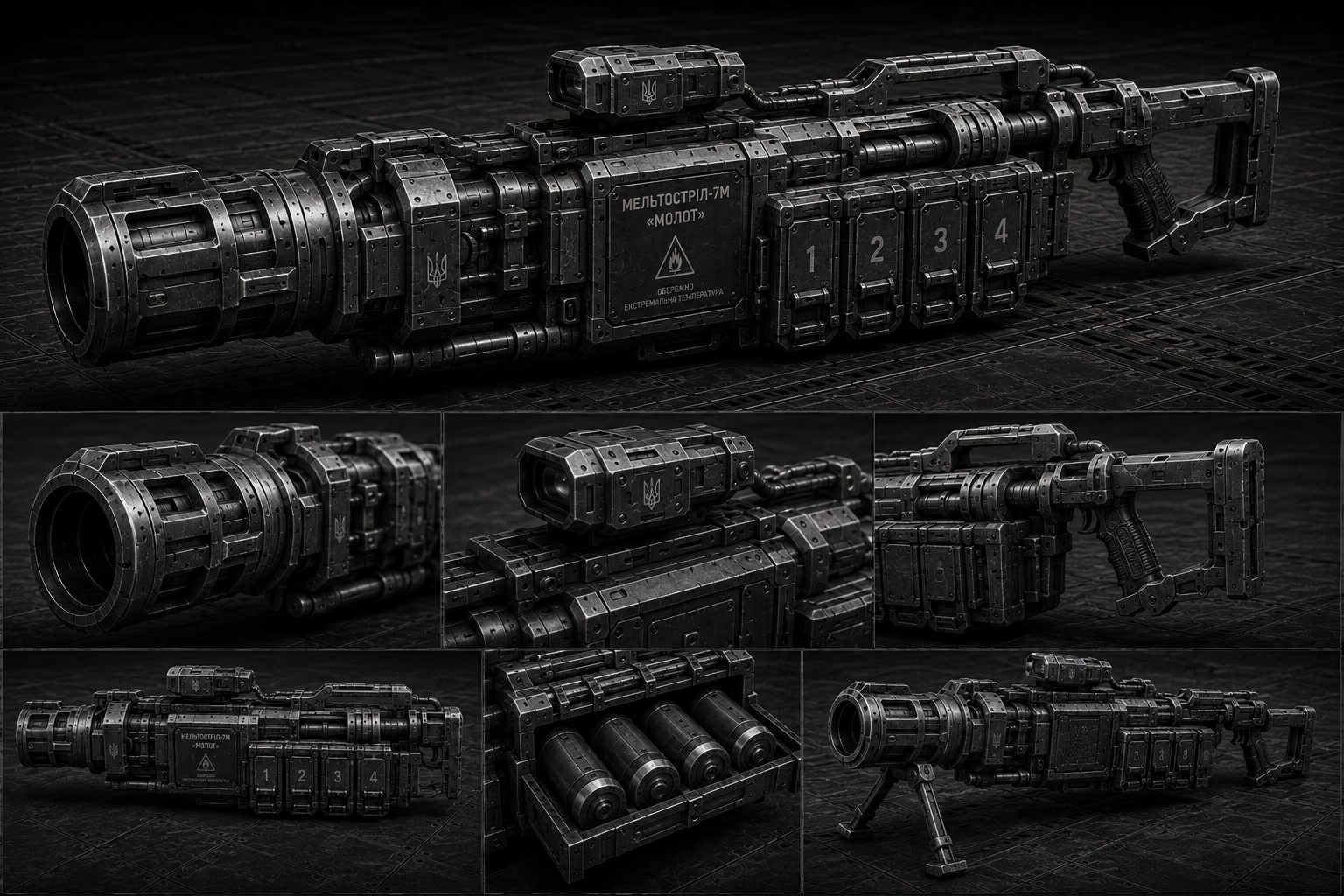 A modernized version for Serdiuk stormtroopers. Weight reduced to sixty-eight kilograms — the limit that a standard Serdiuk exoskeleton can carry without overloading the servos. The magazine is expanded to four cells instead of three, providing an extra shot before reloading.
The main difference between “Molot” and the base “Peklo” is not just reduced weight. Engineers reworked the stream focusing system: the charge became wider and less dense, but at close range this doesn’t matter. In return, the Serdiuk gets a weapon capable of burning an entrance into a bunker, cutting through the sealed doors of a boarding target, or bringing down a load-bearing wall — and after that, he still has charges left for the fight inside.
“Molot” is purpose-built for Serdiuk assault group tactics: approach, breach, storm, clear. A Serdiuk with “Molot” goes as the second man in an assault pair — the first carries the energy shield, the second levels everything behind the door. After breaching, the melta gunner drops the bipod and continues firing from the shoulder, burning through corridors and compartments.
The drawback is lower penetration depth compared to “Peklo”. Against a main battle tank or heavy fortifications, “Molot” may not be enough. But Serdiuks don’t go tank-hunting with a melta — that’s what Terminators with “Peklo” are for. Their job is doors, bulkheads, pillboxes, and anything that can be breached on the move and immediately entered.
Melta Gun-7I “Inzhener” (Engineer)
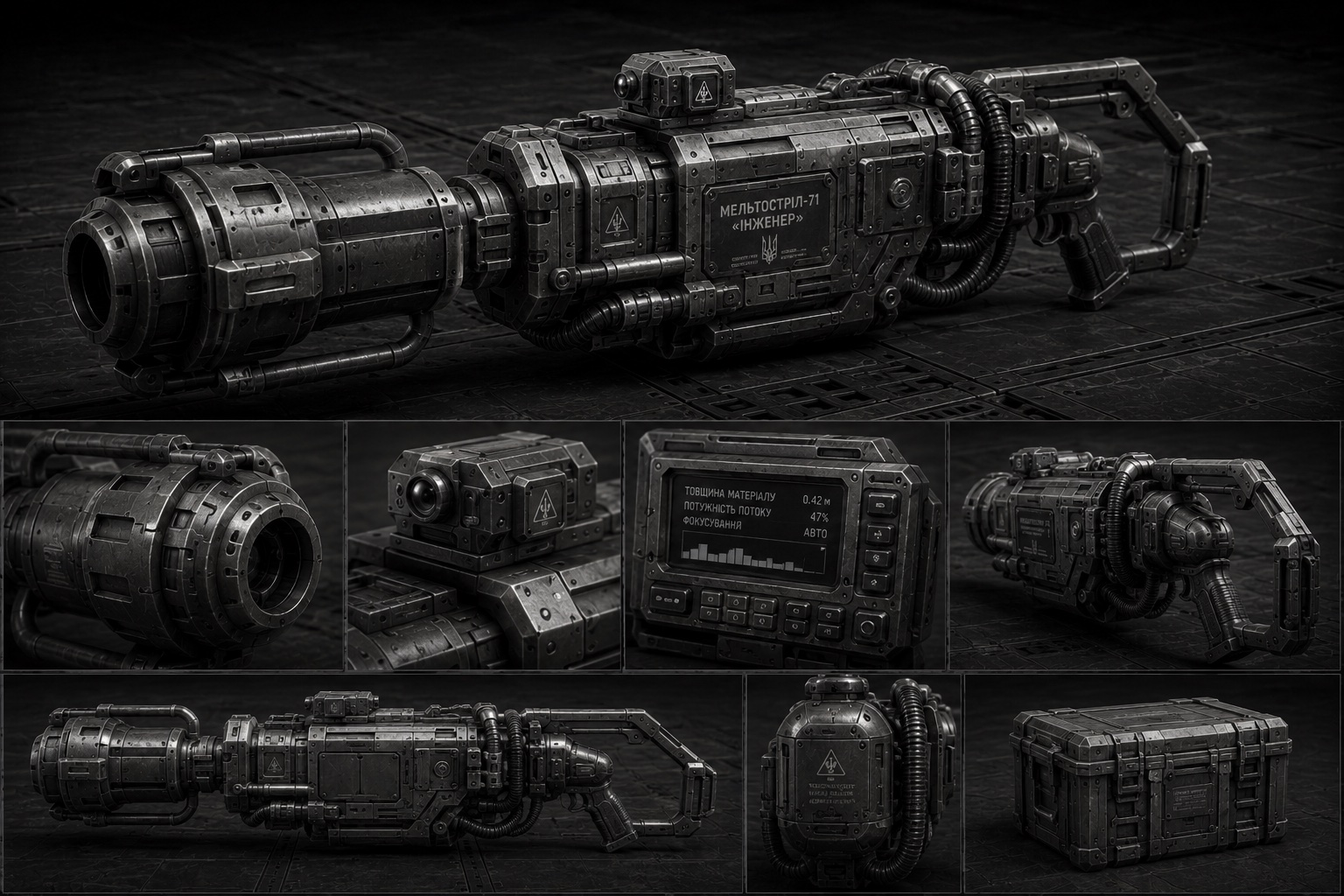 A specialized version for engineering units. Weight — seventy-five kilograms. Unlike combat modifications, “Inzhener” is first and foremost a tool, and only secondarily a weapon. Instead of combat energy cells, it uses a regulated, reduced-power stream — sufficient to cut through sealed airlocks, space station bulkheads, or clear debris. It features an additional laser rangefinder that automatically adjusts stream focusing to the thickness of the material.
The key feature of “Inzhener” is cutting precision. The operator sets the depth and width of the cut on a wrist-mounted tactical computer, after which the melta gun self-regulates the stream density. You can carefully cut a door opening in an armored bulkhead without collapsing the entire wall. You can sever a load-bearing beam with centimeter precision. You can clear debris without setting everything around on fire — although fire safety near a melta is still a relative concept.
During boarding actions, “Inzhener” is indispensable. It is the engineer with this model who cuts a path into the enemy ship while the rest of the team covers him from defenders. A skilled operator can cut a neat circular breach in an armored hull in a matter of minutes — faster than any plasma cutter. In a pinch, “Inzhener” can work as a combat weapon, but you’ll have to crank the power to maximum manually, and after two or three such shots, the precision focusing goes to hell and requires factory recalibration. That’s why engineers protect their tool and only jump into the fight when they’re truly cornered.
Melta Gun-7Sh “Shtorm” (Storm)
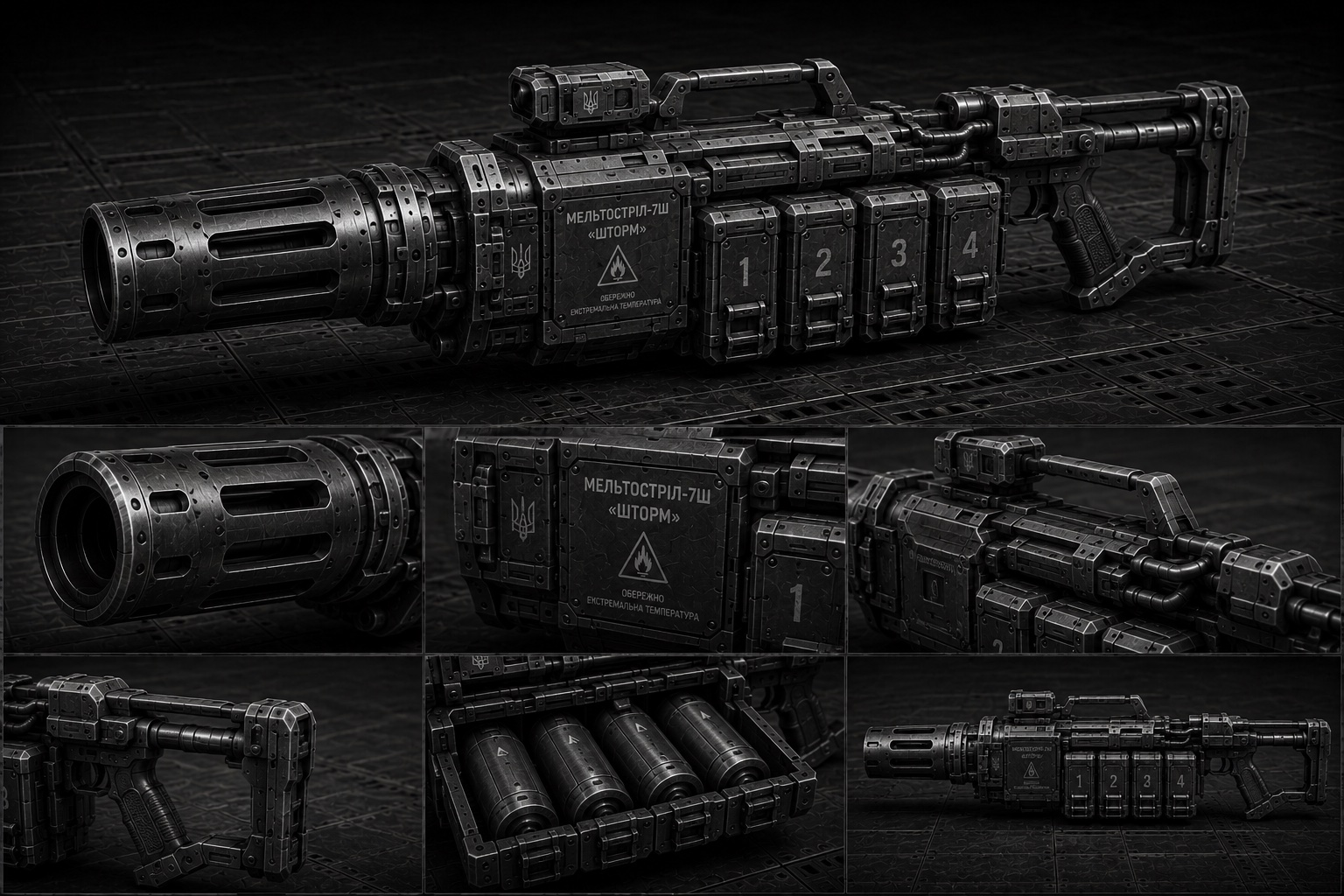 An assault variant with a lightened barrel and reduced weight of fifty-five kilograms — the lightest in the melta gun family. Sacrifices penetration for mobility and speed of fire transfer. The stream is wider but less focused — at close range, it burns out an entire sector in front of the shooter. The favorite weapon of Terminators who specialize in room clearing: one shot, and the room is clear, doors included.
“Shtorm” was created not to punch through tanks, but for close combat in tight spaces — corridors, compartments, casemates, caves. The wide cone of effect allows a single shot to cover several enemy fighters at once or an entire narrow passage. At a distance of ten to fifteen meters, “Shtorm” leaves nothing alive in the engagement sector — it literally burns the air along with those standing in it.
Due to the reduced charge mass and widened stream, “Shtorm” has the lowest heat output of all melta guns — this allows up to five consecutive shots without lockout. For room clearing, this is critical: when you’re entering an enemy bunker, you don’t have time to wait for the barrel to cool. You shoot, move, shoot, move — and keep going until you run out of either charges or enemies.
The main drawback: “Shtorm” is nearly powerless against heavy armor. A main battle tank of other empires has sufficient armor thickness to not even notice a shot from “Shtorm”, especially since you’d have to fire nearly point-blank. But that’s what “Peklo” and “Molot” are for. “Shtorm” is the weapon of the final push, when you need to get inside and clear everything that moves, fast and without unnecessary conversation.
Combat Employment
In the Hetmanate, the melta gun is not a mass-issue weapon. It is issued only to Terminators with marksman specialization and individual Serdiuk stormtrooper groups. A squad typically has one melta gunner, and not always. Due to the complexity of use and the very narrow specialization of employment (room assault and breaching barricades, even more rarely — engaging vehicles), Serdiuks do not always take this weapon into battle.