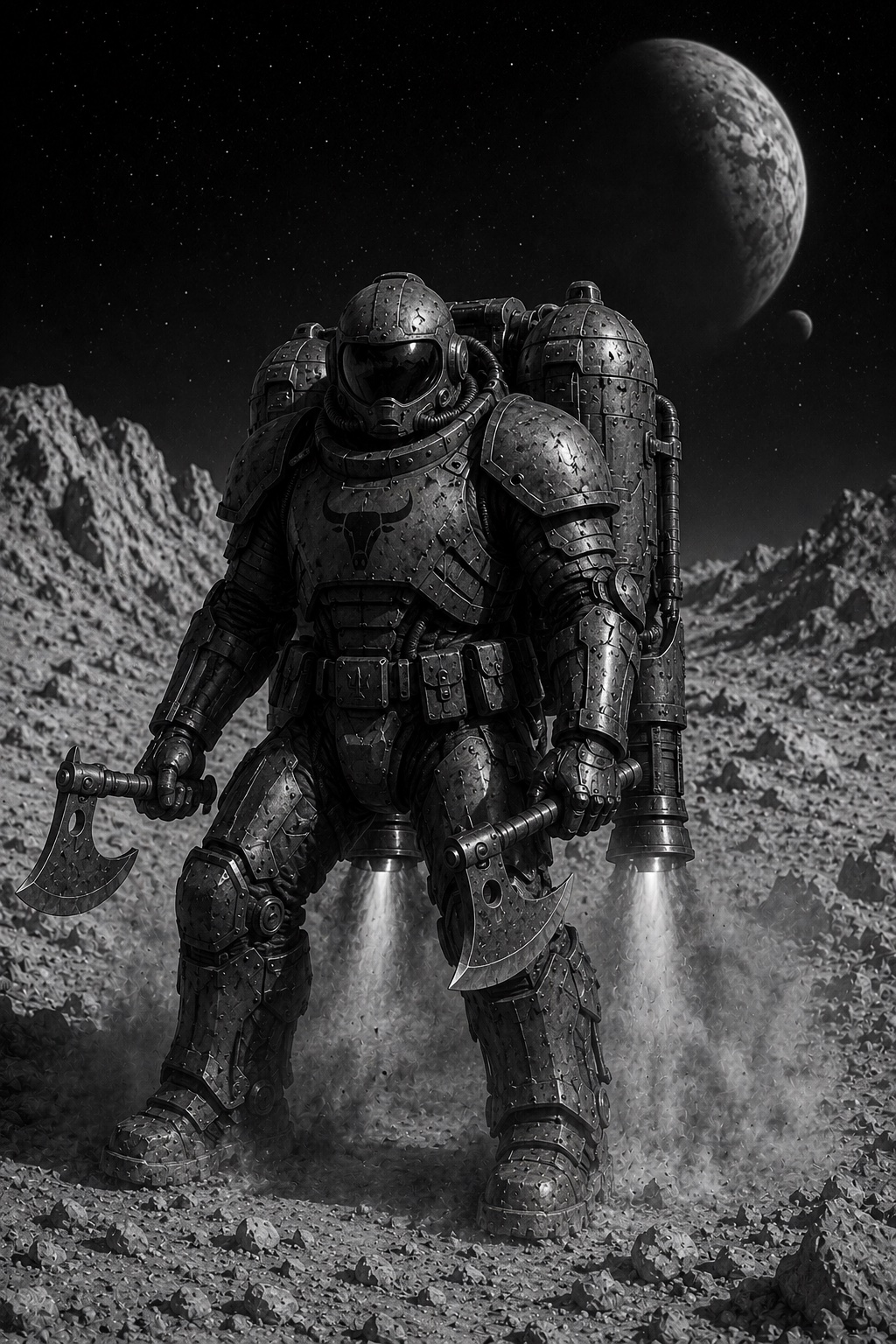
Strike Jet Sotnias (SJS) are highly mobile detachments of Terminators equipped with jet packs for rapid movement across planetary surfaces or for boarding actions in open space.
General Description
The SJS specialization becomes available at the third level of service in the Terminator forces. The primary task in open space is boarding and sabotage operations to disable or capture enemy ships. On planetary surfaces, SJS detachments conduct rapid advances into the enemy rear using jet packs and carry out sabotage activities behind enemy lines.
Structure and Organization
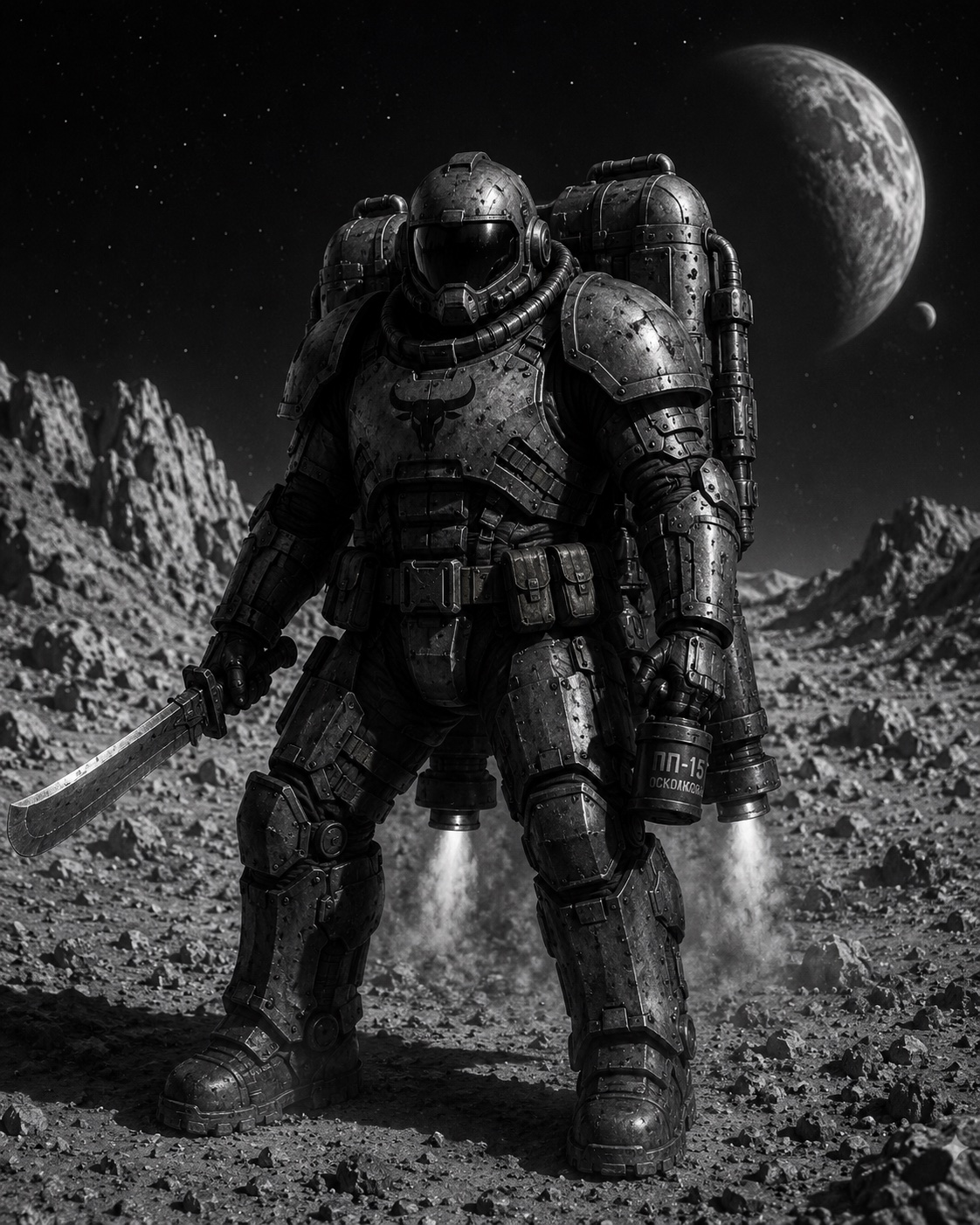
The basic unit of the SJS is the desiatok (10 Terminators). A desiatok is divided into two lankas of five troopers each: the assault lanka (breaching, clearing) and the support lanka (covering fire, engineering). Three desiatky form a sotnia under the command of a Terminator IV. A sotnia operates as an autonomous combat unit, capable of executing missions without support from the main force for a limited time.
Within the space fleet, SJS sotnias are assigned to carriers — specialized ships equipped with launch bays for rapid deployment. A single carrier typically embarks between two and four sotnias.
Equipment
Jet Pack
The standard SJS jet pack (model RR-9 “Kryla”, meaning “Wings”) provides three operating modes: cruise (horizontal travel up to 50 km in atmosphere), jump (vertical ascent up to 300 m or obstacle clearance), and maneuver (short impulses for repositioning during combat). In open space, the pack operates in continuous thrust mode, allowing the Terminator to move between ships or debris over distances of up to several kilometers.
The pack is powered by ultra-high-density batteries integrated with the Terminator armor’s power plant. A full charge provides 10–12 minutes of active operation in atmosphere or up to 20 minutes in space. Once depleted, the battery block must be replaced — performed aboard the carrier or in field conditions with engineering support.
Armor
SJS Terminators use a lightened variant of the standard powered armor, with passive protection elements removed from the lower torso and shoulders. This is done to reduce the overall mass of the “shooter + pack” system and improve aerodynamics during atmospheric jumps. The reduction in protection is compensated by high mobility: a stationary Terminator receives more hits than one that is constantly maneuvering.
Navigation
Each SJS Terminator is equipped with an inertial navigation system integrated with the helmet’s tactical display. During space operations, navigation synchronizes with the carrier’s shipboard sensors, allowing real-time tracking of each trooper’s position. In atmosphere, the system is supplemented by an altimeter and a Doppler velocity sensor.
Armament
The primary principle of weapon selection for SJS is compactness and the ability to fire immediately upon landing. SJS Terminators favor close-combat weapons, short plasma handguns, or shotguns. Plasma and melta grenades are standard kit for every trooper: during a jump, aimed fire is ineffective, so dropping grenades onto enemy positions followed immediately by hand-to-hand combat upon landing is a thoroughly drilled tactic.
During boarding operations, each desiatok receives melta mines for breaching the outer hull of the enemy ship. The assault lanka also carries engineering charges for decompressing compartments and destroying internal bulkheads. The support lanka is equipped with one heavy melta gun for breaching armored doors and suppressing fortified firing positions.
Combat Tactics
Space Boarding
A boarding operation begins with the sotnia deploying from the carrier. Terminators move in a dispersed formation, using maneuver impulses to evade point-defense fire from the target ship. The engineering pair arrives at the hull first, placing melta mines and cutting a passage inside. After the compartment is decompressed, the assault lanka enters first, clearing the space around the breach. The support lanka enters immediately behind them, securing the captured compartment and establishing a foothold for further advance.
Priority targets during boarding are: the bridge, the reactor compartment, life support systems, and communication nodes. The sotnia operates quickly — a typical operation to capture a medium-class ship lasts from 15 to 30 minutes. If resistance is too strong, the sotnia switches to sabotage tactics: destruction of critical systems and withdrawal.
Planetary Deployment
On planetary surfaces, SJS perform the role of forward assault groups. Deployment occurs from low orbit or from an atmospheric carrier. Terminators enter the atmosphere in the cruise mode of their packs, bleeding off speed immediately before landing. The first wave of the landing disperses across the terrain, forming a perimeter, after which the advance toward the objective begins in a series of successive jumps.
The primary tactical advantage of SJS on a planetary theater is the ability to overcome natural and artificial obstacles (rivers, ravines, minefields, fortified lines) without losing the tempo of the offensive. A sotnia can advance up to 30 km into enemy territory in a single bound, if the pack charge permits.
Raid Operations
In deep raid mode, an SJS sotnia strikes enemy logistics nodes: ammunition depots, field command posts, communication hubs. After mission completion, the sotnia withdraws by jumps to the extraction point, where it is picked up by a transport ship or links up with the main force. The duration of an autonomous raid is limited by pack charge and ammunition supply — typically no more than 6 hours of active operations.
Limitations
The primary limitation of SJS is energy dependency. Once the jet pack charge is exhausted, the Terminator loses the main tactical advantage — mobility — and becomes an ordinary heavy infantryman, albeit in lightened armor. For this reason, sotnia commanders always plan operations with a charge reserve for withdrawal.
In atmosphere, the jet pack produces a significant thermal and acoustic signature, making the SJS Terminator visible to enemy sensors. Surprise is achieved not through stealth, but through speed: from the moment of detection to the moment of strike, too little time passes for organized counteraction.
The lightened armor makes SJS Terminators more vulnerable to fire from heavy infantry weapons and static defensive systems compared to Terminators in standard gear. Compensation comes through massed assault tactics: the sotnia attacks as a compact group, denying the enemy the ability to focus fire on individual troopers.